
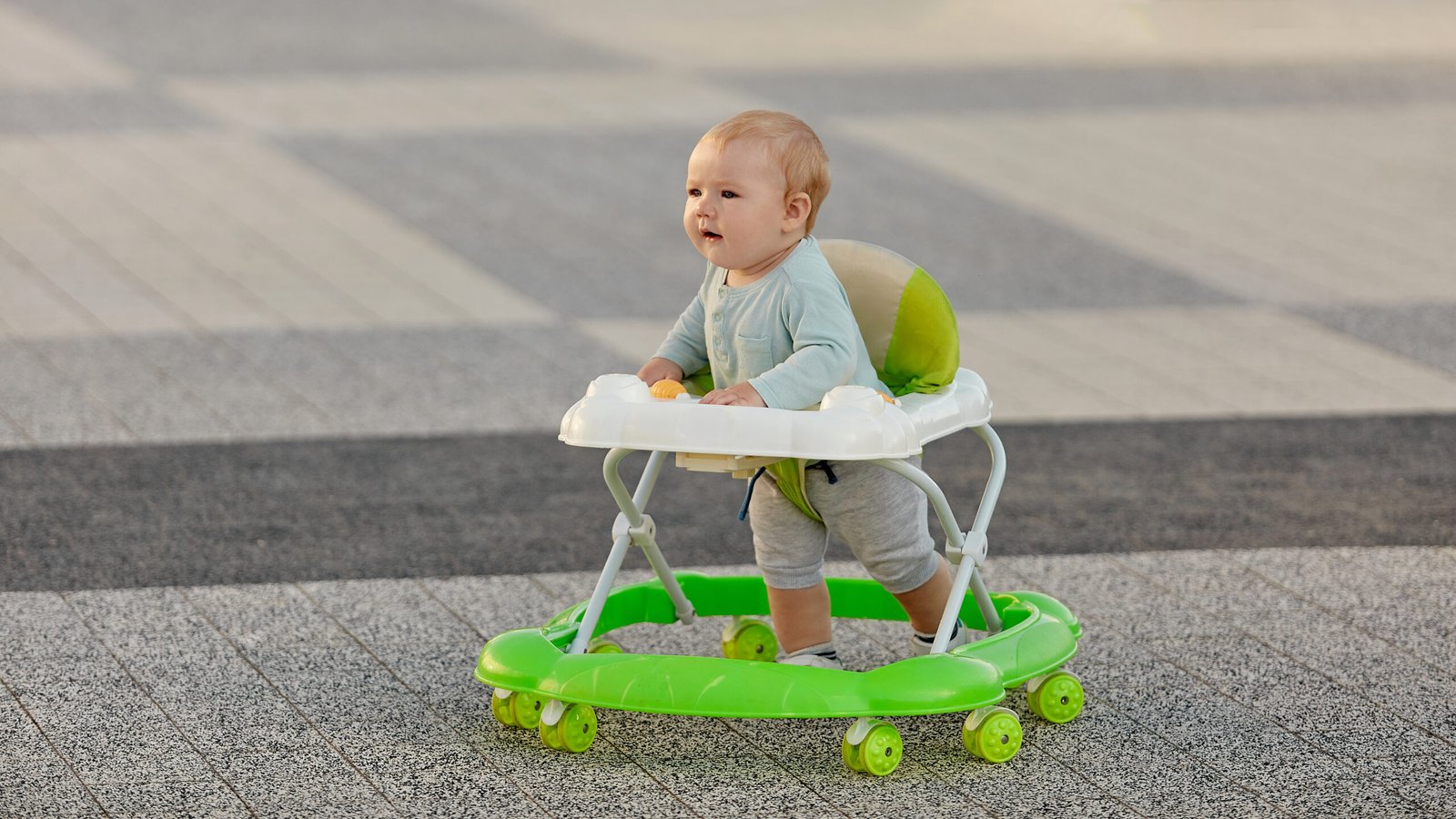
Short answer: No. Pediatricians do not recommend mobile baby walkers. The American Academy of Pediatrics (AAP) has called for a ban on their manufacture and sale in the United States, and Canada banned them outright in 2004. Walkers cause thousands of injuries every year and do not help babies learn to walk. Floor play, a stationary activity center or a sturdy push toy are safer ways to keep a baby busy and moving.
Why pediatricians say no to baby walkers
A baby walker is a seat inside a frame on wheels. It lets a baby who cannot yet walk move around the house quickly, often faster than a parent can react. That speed is the problem.
A study published in Pediatrics in 2018 found that about 230,676 children younger than 15 months were treated in US emergency departments for walker related injuries between 1990 and 2014. Most of these were head and neck injuries, and the most common cause was a fall down the stairs. Other injuries came from reaching things that are normally out of a baby’s reach: hot drinks, stove handles, cords, sharp objects and pools.
Injuries dropped a lot after the United States introduced stricter safety standards for walkers in 2010, from roughly 21,000 a year in 1990 to around 2,000 in 2014. The study’s authors and the AAP still concluded that the risk is not acceptable for a product that offers no real benefit, and they continue to call for a ban.
Do baby walkers help babies walk sooner?
This is the most common reason parents buy one, and it is a myth. Walking depends on balance, core strength and the confidence a baby builds by rolling, crawling, pulling up and cruising along furniture. A walker skips most of these steps. The baby’s legs move, but the frame does the balancing.
Pediatricians note that walker use can even delay walking, because the baby spends less time on the floor practising the skills that walking is built on. A walker also takes away the chance to see and reach for their own feet, which is part of how babies learn where their body is in space.
From a Montessori point of view, the best thing we can offer a baby is freedom of movement on the floor: a safe, open space, a few interesting objects and time. Babies who are given that space tend to find their own way from rolling to crawling to standing.
Why Canada banned baby walkers
On April 7, 2004, Canada became the first country in the world to ban the sale, advertising and importation of baby walkers. The ban also covers second hand sales at garage sales and flea markets. Health Canada explained that children using walkers do not have the skills, reflexes or judgement to use them safely, and that falls down stairs leading to head injuries were typical. A voluntary industry ban had been in place since 1989, but walkers kept entering the market and injuries continued.
Safer alternatives to a baby walker
- Floor time. A soft play mat, a low mirror and a few toys just out of reach encourage rolling, pivoting and crawling.
- A stationary activity center. It looks like a walker but has no wheels, so the baby can stand, bounce and play without moving across the room. Keep sessions short, around 15 to 20 minutes.
- A sturdy push toy. Once a baby can pull up and cruise along furniture, a weighted push wagon or push walker toy lets them practise walking under their own control. Choose one that does not tip easily.
- Cruising routes. Arrange a sofa, a low table and a sturdy chair so your baby can move from one to the next while holding on.
- A baby proofed room. Gates at the top and bottom of stairs, covered sockets and nothing hot or heavy within reach make free movement safe.
If you already have a baby walker
The safest choice is to stop using it. If you decide to keep using one for now, use it only on one floor with a gate across every staircase, keep your baby within arm’s reach the whole time, stay away from kitchens, bathrooms, pools and heaters, and choose a model that meets current safety standards, including a braking feature that stops the walker at the edge of a step.
A short history of baby walkers
Baby walkers are not new. Paintings from the 14th and 15th centuries show wooden “baby cages” and walking stools, and wheeled walkers were patented in the United States in the 1870s. For most of that history they were seen as a helpful tool. What changed was evidence: once hospitals began tracking walker injuries in the 1980s and 1990s, doctors saw how often these devices sent babies to the emergency room.
Frequently asked questions
At what age can a baby use a walker?
Pediatricians recommend not using a mobile walker at any age. A stationary activity center is a safer option once your baby has good head and neck control, usually from around 4 to 6 months.
Are baby walkers illegal in the United States?
No. They are still sold in the US, but they must meet a mandatory federal safety standard. The AAP continues to recommend that they not be sold at all.
Is a push walker toy the same as a baby walker?
No. A push toy has no seat. Your baby stands behind it and pushes, using their own balance and strength. It is designed for babies who can already pull up to stand.
Sources
- Sims A, Chounthirath T, Yang J, Hodges NL, Smith GA. Infant Walker Related Injuries in the United States. Pediatrics, 2018.
- Government of Canada. Minister Pettigrew announces a ban on baby walkers, April 2004.
- Nemours Children’s Health. Doctors, including this one, push for baby walker ban, 2018.
This article is for general information and does not replace advice from your child’s doctor.